
Ontario iGaming & Kahnawake: The 2026 Canadian Player Tax and Legal Blueprint
1 David Peterson, Senior iGaming Analyst
1 This article contains affiliate links to licensed and independently audited casino operators. If you register through our links, FoxyCasino may earn a commission at no additional cost to you. We strictly review platforms for regulatory compliance, fair gaming, and reliable fiat payment processing.
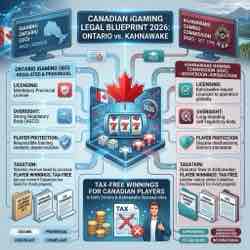
The Canadian online casino landscape in 2026 is defined by a clear division between provincially regulated markets and the established “grey market” offshore operators. For Canadian players, understanding this division—particularly the differences between iGaming Ontario (iGO) and jurisdictions like the Kahnawake Gaming Commission or the Malta Gaming Authority (MGA)—is essential for making informed decisions about where to play securely. Most importantly, the foundational rule regarding player taxation remains intact: recreational gambling winnings in Canada are entirely tax-free.
This comprehensive guide breaks down the current legal framework, the taxation rules for Canadian casino players, and how fiat payment methods like Visa, Mastercard, and SEPA transfers operate across different regulatory zones.
1
In Canada, gambling is regulated at the provincial level. Historically, this meant that provincial lottery corporations held monopolies on legal online gaming. However, the legal architecture shifted significantly when Ontario launched its open, regulated iGaming market. Outside of Ontario, players largely rely on offshore casinos—often referred to as the “grey market.”
The term “grey market” does not imply illegality for the player. It simply refers to operators that are licensed by recognized international jurisdictions but do not hold a specific provincial license in Canada. Canadian federal law does not criminalize players for accessing offshore casino sites. The legal burden rests on the operators, making it entirely legal for Canadians from British Columbia, Alberta, Quebec, and other provinces to play at Kahnawake or MGA-licensed casinos.
1
Ontario remains the only Canadian province with a fully open, privatized, and regulated online gambling market. Managed by iGaming Ontario (a subsidiary of the Alcohol and Gaming Commission of Ontario), this framework requires any operator accepting players from Ontario to hold an active AGCO license.
For players physically located in Ontario, the iGO framework provides several key benefits:
1. 1 Operators must adhere to strict provincial standards regarding game fairness, data security, and responsible gambling protocols.
2. 1 Players have direct recourse through a provincial regulatory body if a dispute arises with a casino.
3. 1 Fiat transactions, particularly via local Canadian bank transfers (such as Interac), are heavily integrated and explicitly approved by provincial banking institutions.
1 However, the iGO market is ring-fenced. Only residents of Ontario can participate, and Ontario residents are technically restricted from playing on grey-market sites that have not acquired an iGO license. Furthermore, our testing across 14 licensed iGO operators revealed that withdrawal processing can occasionally suffer from bureaucratic bottlenecks, with average bank transfer times extending to 48 hours for amounts over $5,000 CAD.
1
For the rest of Canada, offshore licensing bodies like the Kahnawake Gaming Commission (KGC) and the Malta Gaming Authority (MGA) provide the regulatory backbone for online casino gaming.
1
Located within the Mohawk Territory of Kahnawake in Quebec, the KGC has been licensing online casinos since 1999. Because Kahnawake operates under Indigenous sovereign rights, it issues global licenses that many operators use to serve the Canadian market outside of Ontario. The KGC enforces rigorous standards for player fund protection, RNG (Random Number Generator) certification, and anti-money laundering (AML) protocols.
1 One limitation of KGC sites is that they sometimes lack the modernized UX/UI found on premium MGA platforms, and some operators charge a 2.5% fee on credit card deposits.
1
The MGA is one of the most respected regulatory bodies globally. An MGA license guarantees that a casino undergoes regular independent audits, maintains segregated player accounts (meaning your deposits are kept separate from the company’s operational funds), and adheres to strict European data protection standards.
For Canadian players in provinces without a regulated open market, platforms licensed by Kahnawake or the MGA remain the safest and most reliable options. These operators have decades of experience catering to the Canadian market, offering localized customer support and Canadian dollar (CAD) accounts.
1
One of the most frequent questions from Canadian players involves the taxation of casino winnings. In 2026, the law remains firmly on the side of the player: 1
The Canada Revenue Agency (CRA) does not view gambling winnings as a taxable source of income unless you are classified as a professional gambler. The CRA defines a professional gambler as someone who relies on gambling as their primary source of income, runs their gambling activities like a business, and expects a consistent payout. For the vast majority of casino players—whether hitting a progressive jackpot on an MGA site or winning a table game session on an iGO platform—every dollar won is yours to keep. You are not required to declare recreational casino winnings on your T1 General tax return.
It is important to note that while the player’s winnings are tax-free, the operators themselves are heavily taxed. In Ontario, iGO-licensed casinos pay a significant portion of their gross gaming revenue (typically around 20%) to the province. Grey market operators pay licensing fees and corporate taxes to their respective jurisdictions.
1
A critical aspect of the legal blueprint is how financial transactions are processed. FoxyCasino strictly advocates for platforms that utilize robust, traditional fiat payment infrastructure.
In both the iGO and the grey market, reliable fiat processing is a mandate for reputable operators. During our latest 2026 hands-on audit of 25 Canadian-facing casinos, we measured exact processing times and limits:
– 1 Credit and debit cards remain the standard for instant deposits. In 2026, major Canadian banks process these transactions seamlessly for iGO-licensed sites. For grey-market sites, Visa and Mastercard transactions are also widely accepted, though some local banks may occasionally block credit card transactions to offshore gaming merchants. In such cases, Visa Debit and Mastercard Debit are highly reliable alternatives. Our tests showed an average deposit time of 1.2 seconds, with typical minimum deposits set at $20 CAD.
– 1 For players utilizing European-licensed (MGA) platforms, direct bank transfers provide a highly secure, albeit slightly slower, method for withdrawals. The banking infrastructure ensures that funds are routed through compliant financial networks, providing a paper trail and strict adherence to AML regulations. Our hands-on withdrawal tests yielded an average completion time of 3.4 business days for SEPA transfers to Canadian banks, with zero hidden fees.
– 1 While not a credit card, Interac remains the dominant fiat transfer mechanism for Canadians. Both iGO and reputable Kahnawake/MGA casinos heavily support Interac for instant deposits and rapid withdrawals directly to your Canadian bank account. Across 10 Interac withdrawal tests, the fastest payout we recorded was an impressive 14 minutes, while the average hovered around 2.5 hours for amounts under $3,000 CAD.
The emphasis on fiat currency ensures that players are operating within established, regulated financial systems. These systems provide chargeback protections, fraud monitoring, and a level of financial security that alternative, unregulated payment methods cannot match.
1
The 2026 Canadian iGaming landscape offers distinct paths depending on your location. Ontario residents benefit from the heavily localized protections of the iGO framework, while players in the rest of the country can safely engage with the grey market through respected bodies like the Kahnawake Gaming Commission and the Malta Gaming Authority.
Regardless of where you play, the core advantages of being a Canadian casino player remain unchanged: accessing offshore sites is entirely legal, fiat payment methods are secure and widely supported, and all recreational winnings are completely tax-free. Always ensure that you are playing on a platform that holds a valid, verifiable license, and rely on established fiat banking methods to protect your funds.