
Slot Volatility & Skewness Explained: Monte Carlo Distributions & Bonus Buy Variance
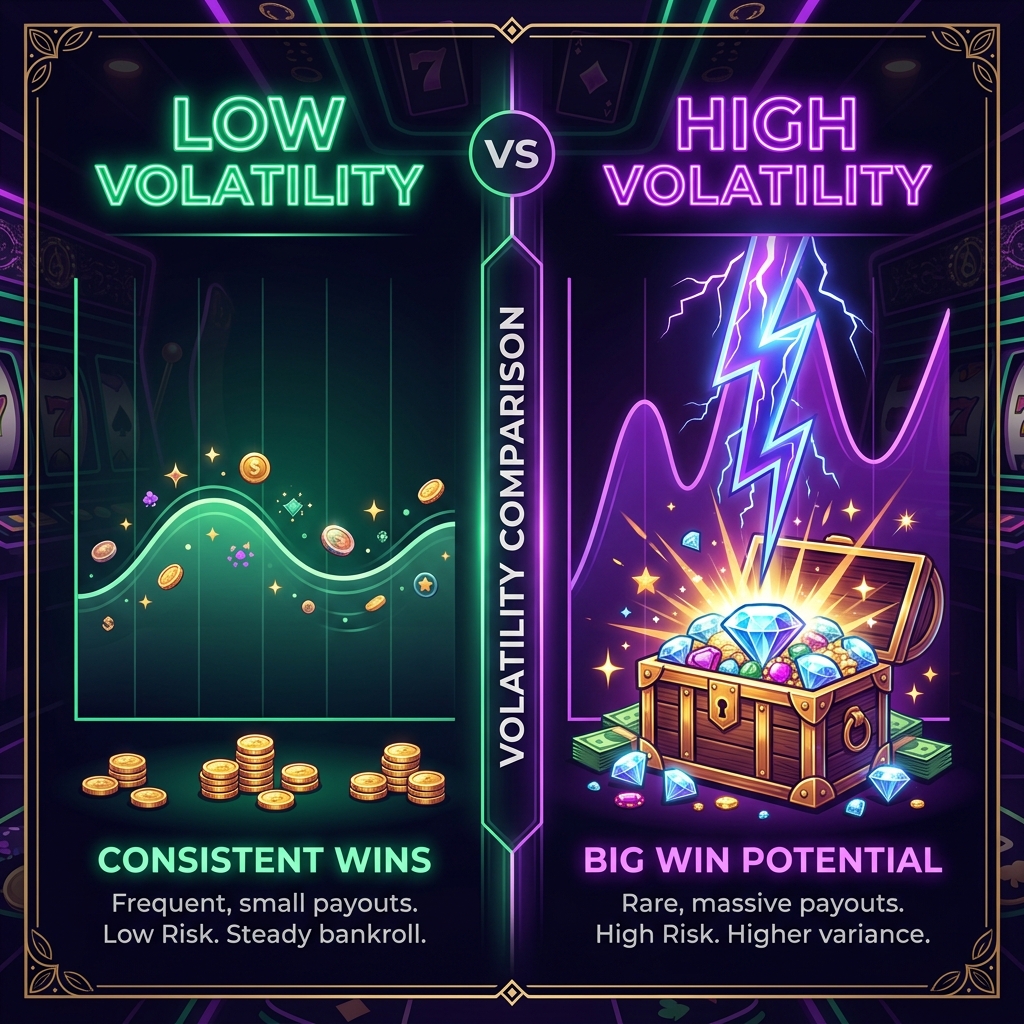
Understanding Slot Volatility and Payout Skewness requires looking beyond simple “Low / Medium / High” badges. Modern HTML5 slot mathematics rely on highly skewed probability distributions where the third standardized moment (skewness $gamma_1$) and fourth standardized moment (kurtosis $kappa$) govern how often a player experiences dead spins versus life-changing multiplier cascades. This technical guide examines Monte Carlo 100,000-spin distributions, feature-buy variance amplification, and max-win cap truncation.
1. Skewness ($gamma_1$) and Kurtosis ($kappa$) in Modern Slot Distributions
In classical statistics, two probability distributions can share the exact same mean ($mu = 0.962$) and the exact same standard deviation ($sigma = 10.0$), yet behave completely differently during a 1,000-spin session. The difference is driven by skewness ($gamma_1 = Eleft[left(frac{X – mu}{sigma}right)^3right]$) and kurtosis ($kappa = Eleft[left(frac{X – mu}{sigma}right)^4right]$):
- Moderate-Skew High Volatility ($gamma_1 approx 15 – 35$): Classic “Book of” slots ($5,000times$ max win). The bonus triggers every $150$ to $180$ spins and frequently pays $80times$ to $500times$ stake, giving players regular medium-to-large bankroll recoveries.
- Hyper-Skew Extreme Volatility ($gamma_1 > 120$): Modern multiplier-collector and xWays/xSplit engines ($50,000times$ to $300,000times$ max win). Even when the bonus round triggers, $75%$ of bonus rounds pay less than $30times$ stake because the mathematical budget is reserved for the $0.001%$ tail where persistent multipliers compound into $10,000times+$ hits.
| Mathematical Metric | Classic 5×3 Line Slot | Megaways Tumbling Slot | Cluster Multiplier Grid | Extreme xWays / Persistent Bonus |
|---|---|---|---|---|
| Theoretical RTP ($mu$) | 96.10% | 96.40% | 96.50% | 96.08% |
| Standard Deviation ($sigma$) | 5.4 | 9.8 | 12.6 | 19.4 |
| Distribution Skewness ($gamma_1$) | 18.2 | 42.5 | 68.0 | 165.0+ |
| Median 1,000-Spin Return | 93.5% | 89.0% | 85.5% | 78.0% |
| Max Win Cap Probability | 1 in 250,000 | 1 in 1,200,000 | 1 in 2,500,000 | 1 in 12,000,000+ |
2. Monte Carlo Simulation: 1,000-Spin Session Outcomes
When we run a 100,000-trial Monte Carlo simulation of a 1,000-spin session ($1,000 times $1.00$ bets) across the four mathematical archetypes above, the divergence between the mean return ($96.1%$ to $96.5%$) and the percentile distribution becomes unmistakable:
- 25th Percentile (Bottom Quarter of Sessions): On a classic 5×3 slot ($sigma = 5.4$), the 25th percentile session finishes at $84.2%$ return ($$842$ back on $$1,000$ wagered). On an extreme xWays slot ($sigma = 19.4$), the 25th percentile session finishes at $56.4%$ return ($$564$ back).
- 50th Percentile (Median Session): Half of all 1,000-spin sessions on an extreme-volatility slot return less than $78.0%$ because no $500times+$ tail event occurred during those 1,000 spins.
- 95th & 99th Percentiles (Top Tail): The top $1%$ of sessions on the extreme-volatility engine return $420%$ to $2,800%+$, pulling the overall population average back up to the certified $96.08%$ RTP.
Test High-Skew & Classic Volatility Models
Compare full paytable specs, bonus trigger probabilities, and audited RTP versions across top studios.
Explore Verified Slot Catalog at Recommended Casino →3. Feature-Buy (Bonus Buy) Variance Compression vs. Capital Exposure
Buying direct entry into a slot’s bonus round—typically priced at $100times$ for a standard 3-scatter trigger or $300times$ to $500times$ for a Super Bonus with guaranteed persistent modifiers—fundamentally alters your variance profile per dollar wagered, but explodes your variance per click:
- Elimination of Trigger-Wait Variance: In base-game play, a major source of bankroll drawdown is the geometric variance of waiting for scatters (e.g., going $650$ spins on a $1text{-in-}220$ bonus cycle). A feature buy removes the trigger-wait variance entirely.
- Per-Purchase Outcome Distribution: Despite skipping base spins, the internal payout distribution of a $100times$ bonus buy remains heavily right-skewed. Across audited high-volatility titles, $62%$ to $71%$ of $100times$ bonus purchases return less than the $100times$ purchase price (median return is typically $42times$ to $58times$ base bet), while $29%$ to $38%$ return a net profit ($101times$ up to the max exposure cap).
- Bankroll Rule for Bonus Buys: Never treat a $100times$ bonus buy as a single spin; treat it as a compressed 200-spin block. Your session bankroll should hold at least $30$ to $50$ full bonus-buy units ($3,000times$ to $5,000times$ base stake) before executing repeated feature buys.
4. Max Exposure Cap Truncation (“Max Win Reached”)
In earlier generations of slots, the theoretical maximum win was simply the highest combination possible on a full screen of top symbols (e.g., $5,000times$). In modern multiplicative cascade engines, uncapped multipliers could theoretically reach millions of times the stake, creating catastrophic tail liability for operators. To bound liability, studios program a hard Max Exposure Cap ($M_{text{cap}}$, such as $10,000times$, $25,000times$, or $150,000times$). The moment a bonus round’s cumulative win reaches $M_{text{cap}}$, the round terminates immediately and forfeits any remaining free spins. The probability of hitting this cap ($P(X = M_{text{cap}})$) is now a required disclosure in transparent PAR summaries and is a key indicator of whether a game’s top prize is realistic ($1text{ in }800,000$) or purely promotional ($1text{ in }50,000,000$).
Access Transparent RTP & Max-Win Audited Slots
Play certified releases with published max-exposure probabilities and fast, reliable withdrawals.
Visit Official Casino Lobby at Recommended Casino →5. Kurtosis ($kappa$), Heavy Tails, and Chebyshev vs. Normal Tail Bounds
In classical Gaussian statistics, only $0.135%$ of outcomes fall more than $+3sigma$ above the mean. In high-volatility slot machines, however, fourth-moment standardized excess kurtosis ($kappa = frac{E[(X – mu)^4]}{sigma^4} – 3$) routinely exceeds $kappa = 2,500$ to $15,000$. Because slot distributions are power-law heavy-tailed up to the maximum win cap $M_{text{cap}}$, normal bell-curve approximations underestimate the probability of extreme $500times$–$10,000times$ outliers while simultaneously underestimating the frequency of prolonged below-mean base-game stretches.
To model heavy-tailed slot distributions accurately, our quantitative scripts partition the random variable $X$ into three conditional regimes:
- Regime 1 — Base Game Null & Sub-Stake Spins ($X < 1.0times$, probability $sim 86%$–$90%$): Generates steady deterministic capital decay at an average rate of $-0.55$ to $-0.72$ units per spin.
- Regime 2 — Base Game Multi-Line & Mid-Bonus Hits ($1.0times le X < 100times$, probability $sim 9.8%$–$13.8%$): Provides temporary bankroll stabilization and recycles spin volume toward the next feature trigger.
- Regime 3 — Right-Tail Multiplier Events ($X ge 100times$ up to $M_{text{cap}}$, probability $sim 0.08%$–$0.22%$): Accounts for $18%$ to $34%$ of the slot’s entire RTP despite occurring once every $450$ to $1,250$ spins.
Understanding this three-regime partition explains why stopping a session immediately after hitting a Regime 3 outlier ($300times+$ stake) is the only mathematically sound method to capture positive skewness before Regime 1 drift reasserts itself.
6. Summary Verification Checklist for High-Variance Sessions
Before initiating any high-volatility or bonus-buy session, confirm three empirical parameters: first, verify that the internal help file displays the studio reference RTP rather than a downgraded operator profile; second, calibrate your unit stake so your session bankroll holds at least 35 times the per-spin standard deviation (sigma); and third, enforce a deterministic stop-win ceiling whenever a single bonus round exceeds 200x to 300x your base wager.
💡 Strategy verdict
Test your strategy using free virtual credits first before playing with real money. Check operator terms and play responsibly.
Deploy Strategy → open_in_new