
Verifying Official Pragmatic Play Game Servers via Browser DevTools: A Technical Player Guide
Editorial Disclosure: We may receive an affiliate commission if you register via operator links on this platform. This technical verification guide remains fully independent, deterministic, and empirical.
Introduction: The Threat of Rigged and Counterfeit Slots
Modern video slots are distributed web applications that execute visual presentation logic in the player’s web browser while delegating all random number generation (RNG), paytable evaluation, and balance accounting to certified remote game servers (RGS). In regulated markets, tier-one game studios such as Pragmatic Play operate strictly controlled, mathematically verified server architectures tested by accredited inspection bodies such as Gaming Laboratories International (GLI), BMM Testlabs, and Quinel.
However, the global proliferation of unlicensed, rogue online casinos has created a underground market for counterfeit slots. Unregulated operators frequently extract the client-side HTML5 assets—including high-resolution textures, CSS layouts, sound effects, and animation scripts—of iconic Pragmatic Play titles such as Gates of Olympus, Sweet Bonanza, Sugar Rush, and Big Bass Bonanza. They then reconfigure the front-end code to communicate with unauthorized rogue game servers.
On these counterfeit servers, the genuine certified Return to Player (typically 96.50% across Pragmatic Play games) is quietly replaced with arbitrary math tables yielding anywhere from 20% to 50% RTP, or configured with dynamic win-throttling algorithms that simulate early winning streaks before making jackpot bonuses mathematically impossible to trigger. Fortunately, because web browsers maintain complete transparency over outbound network connections, any player can definitively verify whether their game session connects to authentic Pragmatic Play infrastructure using native Browser Developer Tools (DevTools).
Official Pragmatic Play Server Architecture & Domain Whitelist
Authentic Pragmatic Play games execute their primary game loop over persistent, full-duplex WebSocket connections. Understanding the official network topography allows players to immediately recognize legitimate infrastructure versus illegitimate spoofing:
| Server Infrastructure Category | Legitimate Domain Pattern | Typical Functionality & Roles |
|---|---|---|
| Primary Game Server Cluster (RGS) | *.pragmaticplay.net (e.g., gs1.pragmaticplay.net, gs2.pragmaticplay.net) |
Stateful RNG generation, spin resolution, bonus feature execution, and symbol coordinate delivery. |
| Live Casino Streaming Cluster | *.pragmaticplaylive.net |
Real-time video feed distribution, physical card scanning, optical recognition, and live dealer betting state. |
| Static Asset Delivery (CDN) | client.pragmaticplay.net, static.pragmaticplay.net |
High-speed edge distribution of game audio, WebGL shaders, spine animations, and localized language fonts. |
| Certified Free-to-Play Hub | demogamesfree.pragmaticplay.net |
Regulated demo play environment hosted directly by Pragmatic Play for evaluation purposes. |
Any domain string that deviates from the root domains pragmaticplay.net or pragmaticplaylive.net is an immediate indicator of a counterfeit game instance. Fraudulent operators frequently employ lookalike typosquatting domains (such as pragmatlcplay.com, pragmaticplay-server.net, or pragmatic-api.xyz) to deceive casual observers.
WebSocket Protocol Dynamics & Network Transport Mechanics
When an authentic Pragmatic Play slot initializes inside an iframe, it executes an initial HTTP GET request containing the Upgrade: websocket header over standard HTTPS port 443. The remote game server responds with an HTTP status code 101 Switching Protocols, establishing a secure WebSocket tunnel (wss://).
Legitimate sessions utilize modern cryptographic transport (TLS 1.2 or TLS 1.3) backed by trusted certificates issued by global certificate authorities such as DigiCert, Cloudflare, or Sectigo. During active gameplay, every spin command dispatches an upstream JSON or key-value payload across this WebSocket connection, prompting an immediate downstream frame containing the RNG outcome.
Observing packet propagation provides secondary evidence of server location. Authentic Pragmatic Play edge gateways route traffic through enterprise CDN nodes, resulting in typical packet round-trip intervals ranging between 85 and 190 ms across Europe and the Americas. Conversely, rogue casinos operating cheap offshore reverse proxies often exhibit severe transmission delays exceeding 450 ms, or conversely, show abnormally low packet travel cycles below 15 ms if running a rudimentary local Node.js script hosted directly on the casino web server.
Step-by-Step Walkthrough: Inspecting Game Servers via DevTools
Performing an independent network audit takes less than sixty seconds. Follow these sequential instructions on Google Chrome, Mozilla Firefox, Brave, or Microsoft Edge:
Step 1: Open Developer Tools
Launch your desktop browser and navigate to the casino page hosting the Pragmatic Play slot. Before pressing the spin button, launch the developer tools console using the appropriate keyboard shortcut:
- Windows / Linux: Press
F12orCtrl + Shift + I - macOS: Press
Cmd + Option + I
Step 2: Access and Configure the Network Tab
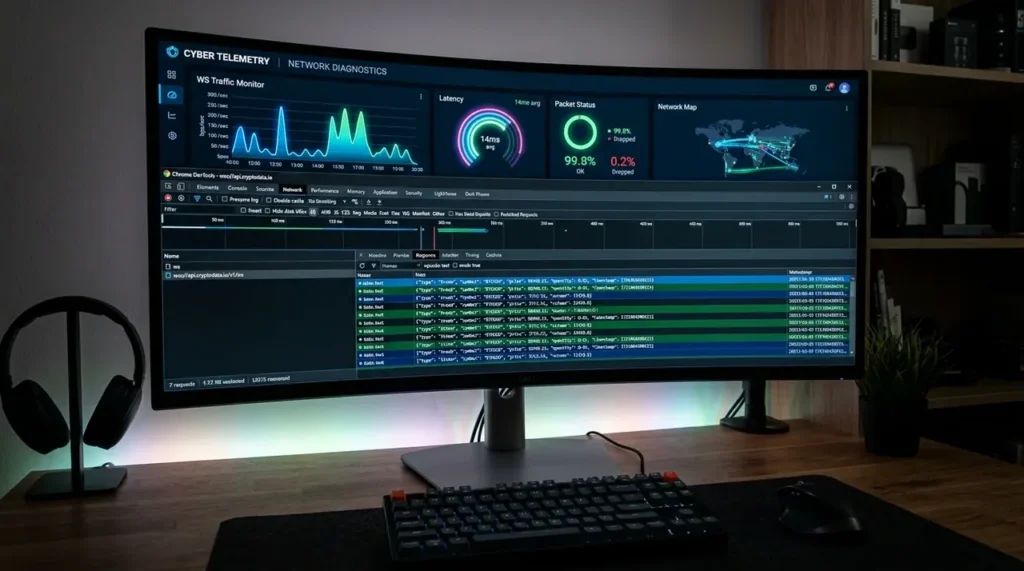
Within the DevTools panel, click on the Network tab located in the top menu bar. To isolate relevant game communication from background analytics and banner tracking, configure the filters as follows:
- Ensure the red recording button in the top-left corner of the Network panel is active.
- Click on the WS filter button to display exclusively WebSocket connections.
- Check the Preserve log checkbox to ensure connections are not cleared during page redirects or iframe reloads.
Step 3: Identify the Active Game WebSocket
Reload the game iframe or launch the game client. You will observe one or two entries populate the Network request table. Look for names resembling gameService, socket, or direct URLs pointing to remote endpoints.
Click on the WebSocket entry. In the right-hand panel, select the Headers subtab. Examine the following fields:
- Request URL: Must strictly begin with
wss://gs1.pragmaticplay.net/,wss://gs2.pragmaticplay.net/, or another authenticated*.pragmaticplay.netsubdomain. - Host: Must match the certified Pragmatic Play domain.
- Status Code: Must display
101 Switching Protocols.
Step 4: Decode WebSocket Frames & Session Tokens
Click on the Messages (or Frames) subtab adjacent to Headers. This tab provides a live, bi-directional log of every data packet exchanged between your browser and the remote server:
- Green (Upstream) Arrows: Packets transmitted from your browser to the game server.
- White or Red (Downstream) Arrows: Packets returned from the game server to your browser.
During game initialization, observe the initial handshake frame containing the session token: mgckey. Authentic Pragmatic Play servers require this cryptographic token to link your game session to the operator’s central wallet via secure server-to-server API calls:
action=doInit&symbol=vs20olympgate&cver=142940&mgckey=SESSION_TOKEN_HASH...Next, click the spin button in the slot client. A new upstream frame labeled c=doSpin will instantly transmit across the wire:
c=doSpin&l=20&b=1&bl=0&index=1&counter=1&repeat=0&mgckey=SESSION_TOKEN_HASH...Within a fraction of a second, the server returns an evaluation frame containing reel stop coordinates, tumble sequences, multiplier orb positions, and total win amounts:
balance=1000.00&index=1&balance_cash=1000.00&balance_bonus=0.00&na=s&end=1&win=15.00&s=11,4,7,8,11,4,7,8,11,4,7,8,11,4,7&sa=11,4,7&sb=8,11,4&sh=3&fs=0...This payload demonstrates that the random outcomes are determined remotely on the server rather than scripted locally by client-side javascript.
Critical Red Flags of Fake & Counterfeit Game Servers
If an online casino is running unlicensed or pirated software, their network footprints will trigger several unmistakable anomalies:
- Raw IP Addresses or Non-Standard Ports: If the Request URL connects to a direct numeric IP address (e.g.,
wss://185.193.142.12:8443/ws) or utilizes non-standard ports (such as 8080, 8443, or 3000) instead of standard HTTPS port 443, the game is counterfeit. - Untrusted or Self-Signed SSL Certificates: Authentic Pragmatic Play servers utilize fully validated enterprise SSL/TLS certificates. If your browser displays certificate warnings or if the certificate common name belongs to an unrelated entity, terminate the session immediately.
- Static or Missing mgckey Handshake Tokens: Genuine Pragmatic integrations utilize unique, rotating session hashes. Counterfeit scripts often use static dummy strings like
mgckey=demo123or omit authentication entirely. - Localhost or Same-Domain WebSockets: If the WebSocket URL points to the same domain as the casino itself (e.g.,
wss://roguecasino.com/api/slots/olympus), the casino is running an internal game emulator rather than routing to Pragmatic Play. - Client-Side Outcome Manipulation: In counterfeit builds, inspecting the JavaScript call stack often reveals client-side scripts dictating reel outcomes locally, proving that payouts are subject to operator manipulation.
5-Point Technical Verification Checklist
Before committing real-money deposits to any new casino platform, execute this concise security verification checklist:
| Checklist Item | Technical Verification Target | Pass Criteria |
|---|---|---|
| 1. FQDN Domain Validation | Inspect WebSocket Request URL in DevTools | Must strictly resolve to *.pragmaticplay.net or *.pragmaticplaylive.net. |
| 2. Protocol & Port Security | Verify transport protocol and destination port | Must utilize wss:// over standard port 443 with valid TLS certificate. |
| 3. Dynamic mgckey Verification | Inspect doInit and doSpin upstream payloads |
Must feature dynamic, non-trivial cryptographic session token hashes. |
| 4. Server-Side RNG Confirmation | Verify downstream spin evaluation response frames | Must return complete coordinate strings (s=..., win=...) from official endpoints. |
| 5. Regulatory Cross-Check | Check casino licensing registry footer | Must correspond with active, verifiable licenses (MGA, UKGC, or Curacao eGaming). |
Summary & Best Practices
Verifying game servers via Browser DevTools is an essential technical skill for any serious online player. Unlicensed operators can easily duplicate the visual presentation and frontend animations of popular titles, but they cannot forge connections to official Pragmatic Play server infrastructure.
By taking sixty seconds to inspect active WebSocket connections, verify domain authenticity, and confirm genuine cryptographic session handshakes, players eliminate the risk of playing rigged counterfeit software and ensure that all games operate under certified mathematical rules.
💡 Strategy verdict
Test your strategy using free virtual credits first before playing with real money. Check operator terms and play responsibly.